
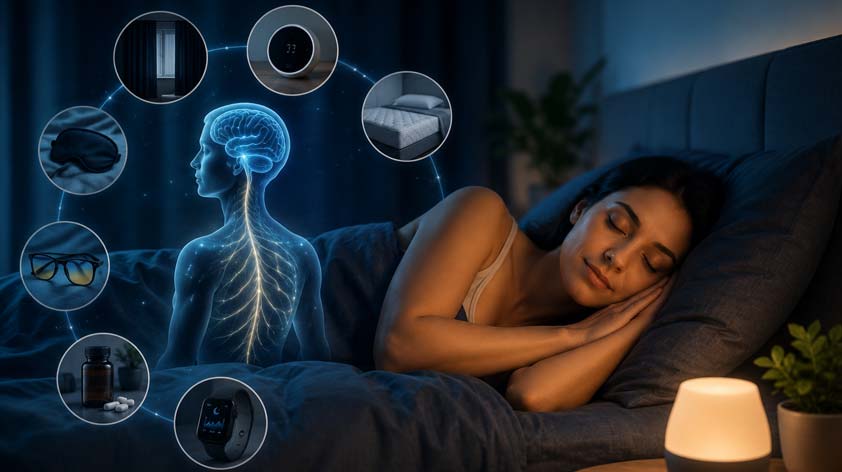
Move over biohacking. There’s a new trend taking over social media, wellness circles, and high-performance communities: Sleepmaxxing.
Sleepmaxxing is exactly what it sounds like. It’s the practice of optimizing every aspect of your life to achieve deeper, faster, more restorative sleep. From blackout curtains and blue-light blockers to magnesium supplements, sleep trackers, and temperature-controlled mattresses, people are investing more time and money than ever into improving their sleep quality.
Why?
Because sleep is no longer viewed as passive downtime. It’s now recognized as one of the most powerful performance-enhancing tools available.
Research consistently shows that quality sleep supports memory, mood, immunity, recovery, metabolism, creativity, decision-making, and longevity. Poor sleep, on the other hand, has been linked to increased stress, anxiety, weight gain, inflammation, and reduced cognitive performance.
But despite all the gadgets, supplements, and sleep routines available, many people still struggle with the same problem:
They can’t switch off.
The body is tired, but the mind is still racing.
This “tired but wired” state is one of the biggest barriers to quality sleep in the modern world. Endless notifications, work stress, financial worries, family responsibilities, and overstimulation keep the nervous system locked in a state of alertness long after bedtime arrives.
This is where true sleepmaxxing begins.
Not with another expensive gadget. Not with another supplement.
But with the nervous system itself.
The fastest way to improve sleep is often to improve the body’s ability to shift from stress mode into recovery mode.
This is the principle behind the 3:3™ Method, a simple breathing technique developed by Raj Khedun that has become increasingly popular among people looking for a rapid nervous system reset before sleep.
Unlike lengthy meditation sessions or complicated breathing protocols, the 3:3™ Method can be practiced in as little as 60 seconds.
Its purpose is simple: help calm the mind, reduce mental chatter, and encourage the body to transition into a more relaxed physiological state.
For many people, the challenge isn’t falling asleep physically. It’s falling asleep mentally.
The mind keeps replaying conversations, planning tomorrow’s tasks, solving problems, or worrying about situations that may never happen.
The 3:3™ Method acts as an interruption pattern. It gives the brain a simple rhythm to focus on while encouraging the body to slow down and relax. Many users report feeling calmer, more centered, and noticeably less mentally activated within moments.
That’s why it fits perfectly into the sleepmaxxing movement.
While smart mattresses, sleep apps, cooling systems, and supplements can all play a role, they are often supporting tools. The nervous system remains the master switch.
If the brain perceives danger, stress, or urgency, sleep becomes difficult regardless of how optimized the bedroom may be.
If the nervous system feels safe and relaxed, sleep often arrives naturally.
The most effective sleepmaxxers understand this.
They don’t just optimize their environment. They optimize their internal state.
A practical sleepmaxxing routine might include limiting caffeine late in the day, reducing screen exposure before bed, keeping the bedroom cool and dark, and finishing with a minute of the 3:3™ Method before getting under the covers.
Simple.
Fast.
Accessible.
No batteries required.
As sleep becomes the new status symbol of health and performance, one thing is becoming increasingly clear:
The future of sleepmaxxing isn’t about doing more.
It’s about finding the few things that work exceptionally well.
And sometimes the most powerful upgrade isn’t found in a supplement bottle or wearable device.
It’s found in your next breath.


