
You can bench press 100kg and still throw your back out picking up a suitcase. You can run a 5K but struggle to squat down to play with your kids. Impressive gym numbers mean nothing if your body can’t perform in the real world. That’s exactly the problem functional fitness training was designed to solve – and it’s why functional fitness has exploded into one of the most searched workout trends of 2026. Backed by leading bodies including the American College of Sports Medicine (ACSM), which ranked it a top-five fitness trend for the year, functional training is reshaping how people approach exercise. Here’s your definitive guide.
What Is Functional Fitness Training?
Functional fitness training focuses on exercises that mimic and improve the movement patterns you use in everyday life – pushing, pulling, hinging, squatting, rotating, carrying, and stabilising. Rather than isolating individual muscles on machines, functional training builds integrated, whole-body strength that makes you more capable, resilient, and injury-resistant in the real world.
The core principle: train movements, not muscles.
A traditional gym approach might involve a leg extension machine to target the quadriceps. A functional approach uses a Bulgarian split squat instead – training the same muscles in a movement pattern that directly transfers to climbing stairs, running, and changing direction in sport.
The 7 Fundamental Movement Patterns of Functional Fitness
All effective functional fitness programmes are built around these seven movement patterns:
| Movement | Description |
|---|---|
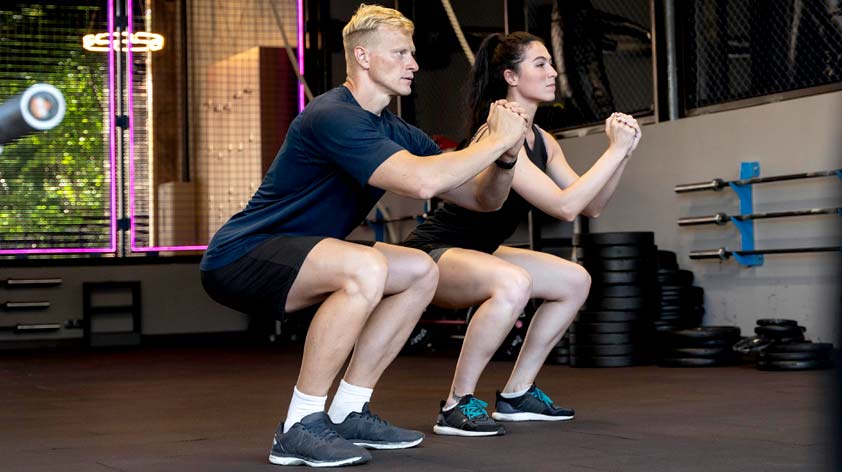
| Squat | fundamental to standing, sitting, and lower-body power (goblet squat, back squat, front squat) |
| Hip Hinge | essential for picking things up safely and posterior chain strength (deadlift, kettlebell swing, Romanian deadlift) |
| Lunge | single-leg strength, balance, and coordination (forward lunge, reverse lunge, lateral lunge) |
| Push | horizontal and vertical pressing for upper body strength (push-up, overhead press, dumbbell bench press) |
| Pull | crucial for posture, back health, and shoulder stability (pull-up, bent-over row, face pull) |
| Carry | core stability and total-body strength under load (farmer’s carry, suitcase carry, overhead carry) |
| Rotation/Anti-rotation | the movement most often ignored and most often linked to back pain (woodchops, Pallof press, cable rotations) |
Build your programme around these seven, and you cover virtually every movement demand life and sport will throw at you.
Key Benefits of Functional Fitness Training
Injury prevention and durability. Functional training strengthens the stabiliser muscles, connective tissues, and movement patterns that injury-prone, machine-based training leaves underdeveloped. Stronger hips, core, and posterior chain mean less back pain, fewer knee injuries, and better joint health.
Improved performance in sport and daily life. The carry strength you build with farmer’s carries transfers to grocery bags. The hip hinge mechanics from deadlifts protect you every time you bend over. The rotational power from cable woodchops makes you more athletic in tennis, golf, football – any sport involving rotational force.
Better body composition. Multi-joint, compound functional movements recruit more muscle, burn more calories, and trigger greater hormonal responses (testosterone, growth hormone) than isolation exercises. The metabolic demand of a circuit of kettlebell swings, goblet squats, and push-ups far exceeds the machine equivalent.
Longevity and healthy ageing. Functional strength is exactly what allows older adults to maintain independence. Research consistently shows that people who train functionally preserve mobility, balance, and muscular strength as they age far more effectively than those who rely on machine-based training.
Essential Functional Fitness Equipment
You don’t need a fully equipped gym. The most effective functional fitness tools are relatively affordable and take up minimal space:
- Kettlebells — unrivalled for ballistic, functional movement training (swings, Turkish get-ups, goblet squats, carries)
- Resistance bands — versatile tools for mobility, activation, and resistance work, especially for pulling movements
- Pull-up bar — a pull-up bar mounted in a doorframe unlocks vertical pulling, hanging, and core work
- Dumbbells (adjustable set) — essential for unilateral (single-limb) training that addresses imbalances
- Sandbag — unstable, awkward loads train real-world carrying strength better than any barbell
- TRX/suspension trainer — bodyweight training with infinite scalability and strong core demand
A complete functional fitness set-up can cost less than a few months’ gym membership.
Beginner Functional Fitness Programme (4 Weeks)
Perform 3 sessions per week. Rest 60–90 seconds between sets.
Session A – Lower Body Focus
- Goblet squat: 3 × 10
- Romanian deadlift (dumbbells): 3 × 10
- Reverse lunge: 3 × 8 each leg
- Farmer’s carry: 3 × 20 metres
- Dead bug: 3 × 8 each side
Session B – Upper Body Focus
- Push-up (or incline push-up): 3 × 10
- Dumbbell bent-over row: 3 × 10
- Resistance band face pull: 3 × 15
- Overhead dumbbell press: 3 × 10
- Pallof press: 3 × 10 each side
Session C – Full Body / Metabolic
- Kettlebell swing: 4 × 15
- Goblet squat: 3 × 10
- Push-up: 3 × 10
- Dumbbell row: 3 × 10
- Suitcase carry: 3 × 20 metres each side
| Day | Session |
|---|---|
| Monday | Strength training (full body) |
| Tuesday | Zone 2 cardio (45–60 min) + mobility |
| Wednesday | Strength training (full body) |
| Thursday | Zone 2 cardio (45–60 min) |
| Friday | Strength training (full body) |
| Saturday | Long Zone 2 activity (60–90 min walk, hike, or cycle) |
| Sunday | Active recovery: yoga, stretching, leisure walking |
Advanced Functional Fitness Movements to Progress To
Once you’ve built a solid foundation over 8–12 weeks, challenge yourself with:
- Turkish get-up — the ultimate total-body functional movement
- Single-leg deadlift — superior for balance, hip stability, and unilateral strength
- Barbell deadlift and squat — add loaded barbell work when movement patterns are solid
- Olympic lifting derivatives (hang power clean, hang power snatch) — explosive power development
- Loaded carries with heavy sandbags — raw, primal functional strength
Common Functional Fitness Mistakes to Avoid
- Skipping mobility work — functional training demands full ranges of motion; if you’re tight, movements break down and injury risk rises
- Going too heavy too soon — master movement quality with lighter loads before increasing resistance
- Ignoring pulling movements — most people overtrain pushing and undertrain pulling, creating the postural imbalances that cause shoulder and neck pain
- Neglecting unilateral (single-leg/arm) work — bilateral movements let strong sides compensate for weak ones; single-limb training exposes and corrects imbalances
- No progressive overload — functional training still requires progressive challenge to drive adaptation
Final Thoughts
Functional fitness is fitness with a purpose. It closes the gap between what you can do in a gym and what you can do in life – and that gap is the one that matters most. Whether your goal is athletic performance, injury-proofing your body, healthy ageing, or simply moving better every day, functional training delivers.
Start with the seven fundamental movement patterns, master them with bodyweight and light loads, and progressively build a body that’s as capable as it looks. Train for the life you want to live.


