
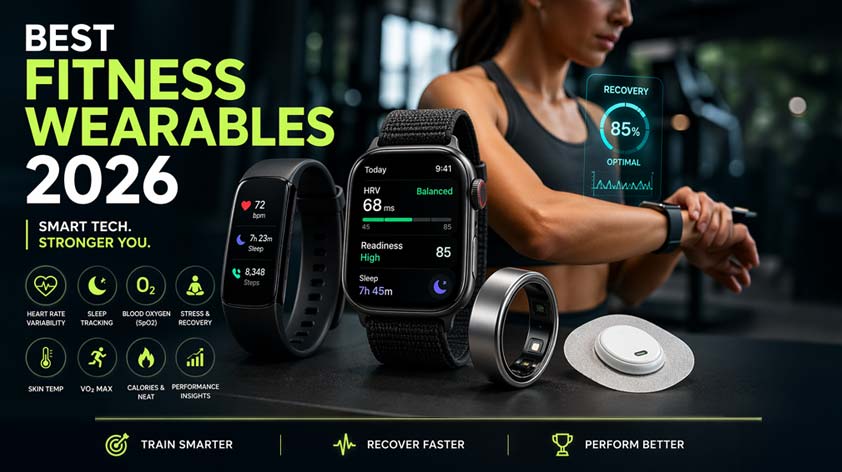
Your wrist knows more about your body than your doctor did ten years ago. Heart rate variability, sleep stages, blood oxygen levels, skin temperature, and stress scores – today’s best fitness wearables 2026 track it all in real time, 24/7. It’s no surprise the American College of Sports Medicine (ACSM) named wearable technology the number one fitness trend for 2026 in its annual Worldwide Fitness Trends report, surveying over 2,000 exercise professionals worldwide.
Whether you’re a seasoned gym-goer, a weekend warrior, or just starting your fitness journey, wearable tech has the power to completely revolutionise how you train, recover, and live. Here’s everything you need to know.
Why Wearable Technology Is the #1 Fitness Trend of 2026
The fitness wearables market has exploded. Smartwatches, fitness trackers, smart rings, and biosensor patches have moved from novelty gadgets to essential training tools. The global wearable fitness technology market is projected to exceed $150 billion by 2027 – and the pace of innovation shows no signs of slowing.
What’s driving the boom? Personalisation. People no longer want generic workout plans. They want data-driven training tailored to their body, their recovery, and their goals. Wearables deliver exactly that.
Key Metrics the Best Fitness Wearables Track in 2026
Modern fitness wearables go far beyond counting steps. Here’s what the top devices now monitor:
Heart Rate Variability (HRV)
The gold-standard marker of recovery and nervous system readiness. High HRV means your body is primed to train hard. Low HRV means it may be time for a rest day.
Resting Heart Rate (RHR)
A rising RHR often signals overtraining, illness, or poor sleep before you even feel it.
Sleep Quality and Stages
Deep sleep, REM cycles, and total recovery time all matter. You can’t out-train poor sleep.
Blood Oxygen Saturation (SpO2)
Critical for altitude training, endurance athletes, and general cardiovascular health monitoring.
Skin Temperature Variance
An early warning system for illness and hormonal fluctuations.
Stress and Recovery Scores
AI-powered algorithms now synthesise multiple data points into an actionable daily readiness score.
VO2 Max Estimates
A powerful predictor of long-term cardiovascular health and longevity.
Calorie Burn and NEAT
These devices also estimate total energy expenditure, including non-exercise activity thermogenesis.
Top Fitness Wearables to Consider in 2026
Smartwatches
Leading the pack are devices like the Apple Watch Series 10, Garmin Fenix 8, and Samsung Galaxy Watch 7. These all-rounders combine GPS tracking, workout detection, health monitoring, and smartphone connectivity in one package.
Fitness Trackers
The Fitbit Charge 6 and Whoop 5.0 cater to users who want deep biometric insight without the bulk of a full smartwatch. The Whoop in particular has become a staple for serious athletes focused on recovery optimisation.
Smart Rings
The Oura Ring 4 has taken the market by storm. Discreet, stylish, and packed with sensors, it delivers exceptional sleep and recovery data in a ring form factor. It’s perfect if you find wrist-based devices uncomfortable during sleep or training.
Biosensor Patches
Emerging continuous glucose monitors (CGMs) like those from Levels and Supersapiens give endurance athletes and metabolic health enthusiasts real-time energy and nutrition feedback directly from their bloodstream. Expect this category to explode in the next 12 months.
How to Use Fitness Wearable Data to Train Smarter
Data is only valuable when you act on it. Here’s how to put your wearable metrics to work:
Use HRV to Guide Intensity
If your HRV is significantly below your baseline, dial back the intensity. Swap a heavy lifting session for a Zone 2 cardio walk or active recovery. On high HRV days, push harder with confidence.
Track Sleep to Optimise Gains
Muscle repair, hormone production, and neural recovery all happen while you sleep. Aim for 7–9 hours and use your wearable’s sleep data to identify patterns that hurt your quality, such as late caffeine, alcohol, screen time, or irregular bedtimes.
Monitor Trends, Not Single Data Points
One bad night doesn’t signal a crisis. Look at rolling 7-day averages for a more accurate picture of your fitness and recovery trajectory.
Set Up Personal Baselines
The most meaningful comparisons are against you, not population averages. Spend 2–4 weeks establishing your normal ranges before making training decisions based on your data.
The Future of Fitness Wearables
The next generation of wearables is moving toward non-invasive blood glucose monitoring, hydration tracking, and real-time lactate threshold detection. AI coaching integrations are also evolving fast – devices will soon communicate with each other and with your personal AI fitness coach to auto-adjust your training plan daily.
Wearable technology is also becoming more accessible. Budget options from brands like Xiaomi and Amazfit deliver impressive accuracy at a fraction of premium prices, meaning data-driven training is no longer the exclusive domain of elite athletes.
Tips for Getting the Most from Your Fitness Wearable
- Wear it consistently, especially during sleep, for the most complete picture.
- Sync and review your data weekly rather than obsessing over it daily.
- Pair your wearable with a training app like Garmin Connect, the Whoop app, or Apple Health for deeper analytics.
- Don’t let data override your instincts. If you feel great on a low-readiness day, a moderate workout is still fine.
- Charge strategically during low-activity windows, such as your morning routine or desk work, so you never miss overnight sleep tracking.
Final Thoughts
The best fitness wearable is the one you actually wear consistently. Whether you invest in a premium smartwatch, a discreet smart ring, or an entry-level fitness tracker, the data you collect over weeks and months will give you insights that no personal trainer, nutritionist, or GP could otherwise provide. In 2026, your wrist – or finger – is your most powerful fitness tool. Use it.
Related searches: best fitness wearables 2026, wearable fitness technology, smartwatch for fitness tracking, heart rate variability training, Oura Ring vs Whoop, fitness tracker benefits, data-driven training, wearable tech health benefits


